Showing posts with label climate and disease. Show all posts

Thursday, January 21, 2010

Harden the f#@& up!

Lately I have been thinking about shifting tides in global psychiatry. For instance the Americanisation of mental illness is becoming increasingly evident, as is the overwhelming propensity for people to pathologise everything that is not neurotypical. Indeed, there is also a growing temptation to diagnose away bad behaviour, or attempt to find some reason why people might just be A-holes. Look at Tiger Woods, after being busted repeatedly burying his iron in the rough, does he man-up and acknowledge that hes a guy-whore with more money than sense? Does he hell...he books himself into rehab for his "sex addiction".

Now other poor sods are finding that after the demise of the Hope and Change Hoe-Down in Copenhagen, their impending demise is making them, well, a bit teary:

Brought to the brink by climate change
Mardi Tindal, the newly elected moderator of the United Church of Canada, returned from last month's climate change summit in Copenhagen with a deep malaise. Not a true clinical depression, but an anxious despair that reduced her to weeping.
"The difference between depression and what I was experiencing is that I wasn't suppressing or finding myself in a place of isolation," she said in an interview about her "lament," and how it helped her to see "the truth about the condition of my own soul."
She was so disappointed by the meeting's failure to reach a binding deal that she broke down in the car one day as her husband drove toward their home church in Brantford, Ont.

The article then trots out a U.K. psychiatrist, Lisa Page:
Dr. Page cites "preliminary evidence" of more extreme possibilities: that suicide increases above a certain temperature threshold; that schizophrenia increases as populations become more urban; and that "impulsivity and aggression could be triggered during periods of hot weather."

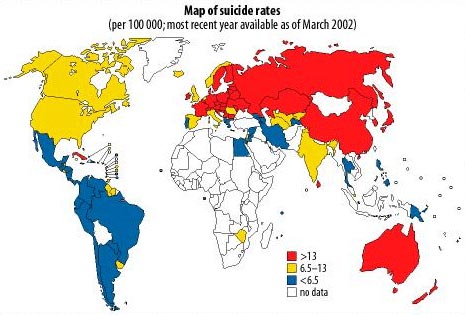
One minute we're talking about someone having a bit of a cry, and the next its suicide and schizophrenia?! I certainly hope Dr. Page has to defend those findings, because we already know that linking suicide with temperature is a rather tenuous association, and that in fact suicides rates tend to be highest in northern Europe. The top five countries for suicide according to the WHO are:
1. Lithuania.
2. Belarus.
3. Russia.
4. Kazakhstan.
5. Hungary.

Which would indicate to me that this might have just as much to do with a socio-politico-economic climate than a meteorological one.


Presumably, Dr. Page is referring to a recent article that examined suicide data from Italy over the last few decades and came to a rather zig-zaggy conclusion that Italian men were more likely to suicide when it was warmer. (But not Italian women. Go figure.) The authors themselves even note that:

It is worth mentioning the somehow speculative character of our interpretation of results, to be weighted against other possible contributing mechanisms
.
Really? You think?

Swiss researchers also set out to look at the relationship of seasonality to suicide, thinking that they would find evidence supporting the classical hypothesis that suicides peak when its warmer. Probably because they didn't think to hook this study up to climate change, they discoverered something completely different instead:
To summarize, the results show unexpected associations between monthly suicide and temperature data. Contrary to overall seasonality, the associations based on monthly residuals emerge mainly during the winter months. In analogy to the overall seasonality, suicides that are performed outdoors appear to play again a major role. The results suggest that temperature and similar meteorologic variables contribute little to our understanding of the overall seasonality in suicide, even though the meteorologic variables are involved indirectly in various ways.

Translation: Instead of finding that suicides are higher when its warmer, they discovered that most suicides correspond with winter, with a secondary peak during summer when people are more likely to suicide in the great outdoors.

We also know already that rates of schizophrenia are higher in people who are born in winter in climates with low levels of winter sunlight exposure. The most striking epidemiology came from the high level of schizophrenia in second generation Afro-Carribean migrants to the United Kingdom. Schizophrenia has thus been linked with a low level of maternal vitamin D during the third trimester. (To joint the long list of other diseases that seem to be linked with inadequate vitamin D levels: Heart disease, diabetes, cognitive impairment, cancer...theres more, but I have a short attention span and got bored listing them.)

If I met an individual in person who was feeling really down about the fact we are all going to die of climate by tuesday because Copenhagen went bosoms up, I would be very sympathetic to them. I'm not a bitch or anything. You can't go around making judgements about other peoples feelings. Feelings are personal and trying to negate someone else's is futility on the level of pushing manure up a hill with a pointy stick. However, on a population level, I would like to request that everyone feeling climate angst of this nature watch this delightfully educational clip (warning: Very foul language included. Don't watch if you are F-word phobic):

Sunday, January 10, 2010

So an Irishman walks into a salt mine and...

Many years ago, while I was studying my second undergraduate degree and generally mispending my youth, I shared a house with two guys from Cork and another from Donnegal. To this day I can still remember how to score pot in Irish Gaelic (although in a fit of Clinton-esque arse-coverage I would like to officially state that "I didn't inhale") and exactly why the name of Irish band "The Pogues" is funny. (It was reportedly meant to be The Pogue Mahones, but they shortened it.)

I'm not sure why I'm telling you all this, except that the climate weather snow has hit Ireland hard, with the government ordering Irish embassy staff in Europe to get chummy with any industry contacts they have to source rock salt and grit, which they are desperately low on. (And no, unfortunately I don't know the Irish for "can you score me a tanker of salt").

This approach actually worked, and they have cut a deal for 25, 000 tons of salt with Poland. A nation that obviously has a soft spot for Ireland after Irish traffic cops inadvertently let Polish drivers in Ireland rack up fines under the singular identity of someone called Prawo Jazdy, or "Drivers Licence" as he prefers to be called at home.

In some areas they have sent the army in to help, and hospitals are also feeling the strain:
Hospitals across the country remained busy, with many reporting a 70% increase in the number of patients presenting themselves at accident and emergency units with fractures requiring treatment. Emergency medicine consultants are reporting that a high percentage of these fractures are complex and require surgery. Doctors in Cork reported treating 1,000 fractures since the cold snap began.
The population of county Cork is only 480, 000. To put this into some kind of perspective, every year approx. 1% of the Australian population suffers injury from a fall. Of that 1%, 15% of those people sustained a fracture as a result of the fall. Thats over the course of a year. Now, its late at night and I get a little innumerate after a hot day and a couple of beers, but I just worked out that gives us a rate of around 32,061 people suffering fall-related fractures a year. Thats like 1 in 666 (gotta love that number) of the entire population of Australia. The population of Cork had about 1 in 480 of its population fractured in a matter of weeks. Ouch.

Monday, December 7, 2009

Ecologists helpfully point out that doctors are crap at science

In a stellar example of how I am prepared to take one for the team in preparing these blog posts, I just sat down and read a series of articles presented in the April 2009 edition of Ecology.
It seems to have taken ecologists a little while to notice what the health professionals were running around saying about climate change invariably increasing infectious diseases and how vector borne diseases are already on the rampage. Possibly because, as Kevin Lafferty, the author of the paper that sparked the recent debate notes:

"For many ecologists, interest stops at the surface of the organism they study."

Now that they have noticed some of the highly questionable things that have been said, ecologists have weighed in on all sides of the debate in an Ecology forum. Even though there was some disagreement in the ranks about the extent that climate will drive infectious diseases, they all seemed to be in agreement that its not as simple as everyone has been making out, and it is often very hard to pinpoint where the effects of climate on disease begins and ends when taken into consideration with all the other inter-related variables. Also interesting to note was the fact that in most of the articles, the inference was that climate change was being discussed from the perspective of climatic variabilities, and not so much from a purely anthropogenic perspective.

Kevin Lafferty, from the U.S. Geological Survey's Western Ecological Research Center, notes in his article The ecology of climate change and infectious diseases, that:

although the globe is significantly warmer than it was a century ago, there is little evidence that climate change has already favored infectious diseases. While initial projections suggested dramatic future increases in the geographic range of infectious diseases, recent models predict range shifts in disease distributions, with little net increase in area. Many factors can affect infectious disease, and some may overshadow the effects of climate.
Richard Ostfield, from the Cary Institute of Ecosystem studies then weighs in with an article entitled Climate change and the distribution and intensity of infectious disease, in which he notes:

...unequivocal demonstrations of a causal link between climate change and human infectious diseases are rare (albeit increasing). Some diseases are likely to decrease in incidence and range with climate warming (Harvell et al. 2002), and others are likely to respond to precipitation or humidity more than to temperature, leading to poor predictive power under warming scenarios. Many diseases are strongly influenced by other ecological, sociological, economic, and evolutionary factors besides climate change.

In his concluding thoughts, he summises that "clear effects of climate change have now been established for several human infectious diseases" but then follows it up with the caveat:

Hay et al. (2002) close their critique of climate drivers of highland malaria by asserting, ‘‘The more certain climatologists become that humans are affecting global climates, the more critical epidemiologists should be of the evidence indicating that these changes affect malaria’’ (Hay et al. 2002:909). Good science demands that skepticism be applied equally to evidence for and against climatic effects on disease.

Mercedes Pascual and Menno Bouma then disagree on the basis that disease range shifts due to temperature are important (Do rising temperatures matter?) and that even if you think temperatures don't matter, then human activities such as changes in land use may increase infectious diseases anyway.

Harvell et al then use diseases in coral (these are ecologists remember) to point out that they think there is evidence of climate as a disease driver (Climate change and wildlife diseases: When does the host matter the most?), but then acknowledges that its complicated and host reactions and immune response may be important, too.

Then Andy Dobson from Princeton does a whole bunch of complicated things with numbers in
Climate variability, global change, immunity,and the dynamics of infectious diseases but seems to work out, among other things that:

Ultimately, the observed increase in malaria cases represent a complex interaction between climate change, human population expansion, the evolution of drug resistance, and the rapid expansion of the AIDS epidemic.
Teasing out the relative importance of each requires careful analyses of nonstationary time-series data where long term trends in global change, and annual seasonal variation in external forcing, interact with the intrinsic tendency of epidemic systems to cycle; this can produce very complex dynamics that defy simple statistical analysis.
Then reassures the reader that if you can give him lots of money he'll be happy to work it out for you.

My absolute favourite response comes from Sarah Randolph, a zoologist from Oxford, who points out in Perspectives on climate change impacts on infectious diseases, that over the last 450 million years so many species have become extinct that we really shouldn't get so worked up about a few climate related shifts in species distribution. She points out that the only reason we are getting so hysterical is that those species shifts might be pathogens that directly or indirectly affect homo sapiens. In summary, she says:

The complexity within each disease system emphasizes that any expectation of a simple consistent response to climate change, i.e., a universal worsening of the situation, is ill founded.
Hitherto, there is no single infectious disease whose increased incidence over recent decades can be reliably attributed to climate change. The often-repeated statistic, that climate change is currently causing approximately 150 000 extra deaths per annum, may be stamped with the authority of the World Health Organization (Campbell-Lendrum et al. 2003), but is, in the opinion of many practicing disease ecologists, inestimable. Furthermore, large as this number is in terms of bereavements, it represents only ;0.15% of all-cause deaths (as a first approximation, assuming a global population of 6.7 3109 and mean life expectancy of 67 years). Other, more avoidable, causes of premature deaths from infectious diseases deserve more attention than climate change.


So, in general, even though they seemed to be quibbling about which bit goes where (remind me never to get a bunch of ecologists to put together an Ikea cot), they all seem to be in agreement that:

1. Its complicated.
2. We don't know much and need to learn more.
3. Nobody should have left the public health mob, the sociologists and the climate scientists unsupervised for so long.
4. Scientific debate and skepticism is a really good thing.

If you made it to the end of this post with me, congratulations! Now as a reward, you can go to my last post and watch the models strip off in the name of carbon reduction.

Thursday, October 29, 2009

Its head explody time again...

Its that time of year again, when people in southern Australia are all battling the horrors of hayfever, seasonal allergic rhinitis, or, as I prefer to call it, Head Explody.


Australia got the arse end of the stick when it comes to seasonal allergies, we're definitely mixing it up with the big boys in the global sneezing stakes (ISAAC study, 1998):


Another article has worked out that: "Australia has a high prevalence of atopic disorders, ranking among the highest in the world". Oh, fab. We also know that atopy is increasing across the world, but that it appears to be a disease that is particularly a scourge of developed nations.

Nonetheless, it doesn't stop articles like this popping up every now and again:

Global Warming May Worsen Hayfever
Global warming could bring more hay fever, according to government research that shows ragweed produces significantly more pollen as carbon dioxide increases.

Now kids, can anyone spot the non-sequitur in that?

I will concede that CO2 fertilisation could crank up the pollen output, its plant food, after all, but buried in this is the logical fallacy that carbon dioxide levels are synonymous with global warming, ergo global warming is causing an increase in hayfever.

Another, more important issue is that rising pollen levels will only cause misery for those people who are already atopic, and increasing atopy in industrialised nations is far more likely to be attributable to such factors as the hygiene hypothesis. (In a nutshell, that early exposure to microbial infection at critical points in development helps to shift our immune system towards producing chemicals that are less likely to cause the inflammatory reactions of atopy. Wow, I can't believe I got that down to one sentence.)

So if you ever needed an excuse to explain why your children are in the backyard eating dirt mixed with possum poo, you now have a fairly compelling one. Additionally, CO2 fertilisation affects all plants, not just that pain-in-the-arse ragweed and rye grass, so there is an upside to this, somewhere, I just can't think of it right now because my head is exploding.

Whether the weather: Climate schmimate

A few months ago, one of my kids (let's call him "Thing no. 3") decided to go all croup-y and respiratory distressed, thus necessitating a post-midnight trip to the local party-hard-capital-of-the-Universe, the Emergency Department.
Naturally, once the adrenalin and cortisol levels brought on by an exciting trip to the hospital had kicked in, and we were in the nice, warm, climate controlled hospital environment, Thing 3 immediately category 5-ed himself, which was both a relief and slightly embarassing. For those of you who haven't had to do any emergency triage lately, category 5 is the "running around yelling "wheeee"" category, as opposed to the "arriving dead - crap, we'd better do something about it right now" category 1 at the opposite end of the scale.
While Thing 3 ran around the paeds waiting room entertaining the other, distinctly un-sick looking kids, I had ample time to catch up on my television infommercials and think thoughts of health and climate.

Viral croup has long been recognised as cropping up in epidemics during the winter months, and often is most acute at night-time when children's bedrooms are colder. This is such accepted epidemiology that most guidelines and textbooks don't even bother referencing these factoids (but if you're really keen you can lit search it yourself if you don't believe me - or alternatively, Listen To Your Mother. She knows.) However, I would probably stop short of saying that Thing 3 got struck by the climate. He had a higher likelihood of getting croup because of the climate, but was probably more likely a victim of the weather. If he had the same viral infection on a warmer evening, he might not have gone all dramatically Sarah Bernhardt on me in the middle of the night.

There seems to be a bit of mis-use or mis-appropriation of the word climate in health care. Climate is a valid determinant of health but is not often a causative factor of mortality. Weather is much more likely to off you, but when can you blame weather and when can you blame climate? Climate is an average across a period of time or across a geographic span across time. Weather is what is happening right now in a given spot. So if you get caught out in a blizzard, I would probably say you got killed by the weather. Sure, you probably lived in a cold climate to have blizzards (or were spectactularly unlucky and should be written up in Fortean Times), but I would probably say the weather got you. If you got cataracts or skin cancer and lived in Australia, I would say that climate could be a part of what caused it (that and probably being caucasian), but skin cancer and cataracts are generally cumulative processes that occur over time, just like "climate". You couldn't definitively pick the one sunny day that did it, you can just extrapolate a bit from statistics.

Given that labelling "climate" as an actual directly causative factor of mortality (when you really mean "weather") is a bit on the fuzzy side, one would think that attributing deaths to "climate change" is plunging logic deep into hazy land. Pardon me my cynicism, but one suspects that the overall fuzziness of the association might be the point of the exercise. It often doesn't occur to anyone to question it, "wait...you said what, now? Exactly how do you figure this?"

Contrary to much popular belief, its actually pretty bad for your health to live in a colder climate. Sure, you get wa-ay more exciting parasites in the tropics, but much of the warm latitudes mortality can be attributable to the fact that that is where many of the world's poor people live. (Should I include Florida in that? I'm not sure...)

For instance, if you were worried about keeling over from heart disease, and hey, who isn't - ischaemic heart disease and cardiovascular disease are the top two causes of mortality in Australia, you are more likely to do so in winter. This could be for a variety of reasons, and the fact that spikes in overall mortality in developed nations in winter correlate with influenza rates is either part of the problem or at least doesn't help much.

Last year, the American Heart Association published a paper called "The "Sunshine Deficit" and Cardiovascular Disease", which neatly summarised some of the more recent research and thinking in this area. They noted that:

Vitamin D deficiency links to cardiovascular disease can be found in a number of studies demonstrating a 30% to 50% higher cardiovascular morbidity and mortality associated with reduced sun exposure caused by changes in season or latitude. Conversely, the lowest rates of heart disease are found in the sun-drenched Mediterranean coast and in southern versus northern European countries. Cardiac death has been reported to be the highest during winter months.

It would seem that these days you can blame Vitamin D deficiency for almost everything, and much of this began as a process of inquiry into why morbidity and mortality could be epidemiological correlated with latitude, season and weather. There is lots of fascinating biochemistry (if you're into that sort of thing) about the role of Vitamin D being discovered as a result, and we may get bored with the Vitamin D hypothesis in the future or figure out it's a bit more complicated than we thought. Be this as it may, the statistical relationship between morbidity, mortality and temperate climes still remains, regardless of the present explanation de jour.

So back up off of blaming everything on global "warming", or worse yet, climate "change", unless you can tell me explicitly in 150 words or less why you should be allowed to use the word "climate" as a causative factor for mortality in the first case. Then we can argue the "change" bit later...