Showing posts with label vector borne disease. Show all posts

Monday, January 18, 2010

The weekly vector-borne WTF?

How could the "international peer-reviewed journal" called Global Health Action have escaped my notice for so long? (I like that they use the word ACTION, but they had me at "Global", anyway). Their home page is decorated with pictures of mosquitoes and polar bears, so I instantly knew I was on the right track.

Just recently they published an Australian article: Climate change could threaten blood supply by altering the distribution of vector-borne disease: an Australian case-study, (available here) which is basically concerned with the fact that during a recent dengue outbreak in far north Queensland, regional blood supplies ran low due to transfusion service bans on collecting from people who were in, or had been to, the dengue prone area.

I've discussed before this the many reasons why climate change is not linked to an increase in vector-borne diseases so much as public health is. You can find stuff on the topic here, here and here. No need to rehash. So on to a discussion of dengue in Australia.

The main dengue vector, Aedes aegypti is apparently an introduced species to Australia, but has been here long enough that it's probably not useful drawing the distinction, except to point out that its highly likely they haven't reached the limit of their possible distribution across the country. There are other mozzies that can be dengue vectors in Australia, but the thing about Ae. aegypti, is that its an urban mozzie. According to the UNSW mosquito nerds:

It is assumed that Ae. aegypti is the vector of greatest concern because of its distribution and close association with humans. Ae. aegypti is predominantly a day-biting mosquito whose larvae may be found almost exclusively in clean water in man-made containers such as water-barrels, rainwater tanks, wells, vases, tyres, bottles, tins, and most other water-holding containers found in the domestic environment. Although the species is currently restricted to Queensland, there are past records of Ae. aegypti being found in NSW, the NT and WA.

Interestingly, the UNSW crew also note that:
Ae. albopictus, poses a threat to Australia. It is an important vector that has been introduced from Asia to many countries, as eggs or larvae transported in artificial container habitats such as used motor vehicle tyres, and water barrels on ships. If it was introduced to Australia it is likely it could readily establish and present a threat for dengue transmission.

This cute little stripey bugger was made famous (if you hang out in the right cirlces and don't get out much) by turning up unannounced many years ago in Houston in the USA, after hitchiking from Asia in used car tyres or such. A past-time that is distinctly unrelated to climate change. (If we wind up with ae. albopictus immigrating from Asia, we can console ourselves with the fact that we have already shipped red-back spiders to Japan).

The fact that Ae. albopictus made its way all the way from Asia to the US would make it seem likely it could handle the little tootle across from New Guinea (where it is already) to the Torres Strait. Especially considering our northernmost island of Saibai is something like, 4 or 5 km away from the New Guinea mainland. Oh, wait, too late. Given that it is native to territory as far north as Beijing, there is no reason why it needs the help of global warming to colonise our southern states.

I'm thinking that when it comes to the spread of dengue vectors in this country, climate change is the least worrying possibility. We've got more immediate problems when it comes to vector borne disease knocking on our doors.

A part of the premise of this article is vaguely sound. Yes, I agree, more dengue outbreaks would put a strain on regional blood supplies. They could have written the whole article on this topic, and just omitted all the bits about extrapolating poorly considered "climate change scenarios". Although admittedly that would have buggered up their conclusion a bit, which was:
Unless there is strong intergovernmental action on greenhouse gas reduction, there could be an eight-fold increase in the number of people living in dengue prone regions in Australia by the end of the century.

I think a far better conclusion would be to go away and remember exactly how we went about eradicating dengue from mainland Australia by the 1950's, and which holes in the public health system lined up to allow it to come back in the 1980's.

Saturday, January 16, 2010

A paediatrician who needs to be spanked. Do it for the children.

I have often blogged about the fact of my incidental motherhood. Recently one of my skeptic-spawn has come down with what I am convinced is a bout of giardiasis, sans diarrhea. We just spent christmas in my childhood home in the tropics where the little blobby parasites in question are endemic, and it has been going around the local paediatric population. The only problem is, my dear little infected sproglet doesn't have diarrhea, just all the upper abdominal symptoms, and the local general practice population here in more temperate climes seem pig-ignorant of what a protozoan hoe-down actually looks like clinically. I tried to explain to them that giardiasis often present without diarrhea. Then in desperation I even explained that many other children my kid had been playing with have presented with the tell-tale diarrhea (actually, the way it was relayed to me was that a certain child "vomited mayonnaise out of his arse".)

The fact that some people only get upper abdominal symptoms with giardia infection isn't exactly new, I have a prehistoric parisitology textbook from the 1950s that even makes note of it, and that matches my own clinical and personal experience. After doing a rather puzzled internet search, I uncovered an amazing thing: There is something like 30 giardia fact sheets from around the world that have exactly, and I mean verbatim, the same true, but clinically misleading information on them. The CDC and the New South Wales health department among them. Whereas my ancient parisitology textbook was written by a boffin who based his information purely on what he saw himself down a microscope and in the people who he presumably chased for stool samples.

We are becoming a profession of gullible rubes. Its so easy to go and google something that nobody stops to think about what they actually see in front of them. Or what that crotchety old GP spent fifty years seeing in front of him, and then told you about. I'll admit tropical medicine is my schtick, I wouldn't know a chillblain if I found one on my arse, but I found it disturbing that if you got all of the GPs together that I have had to see in the last week, you would probably get one knowledgable doctor in the aggregate.

So I'm sitting here nursing a good head of hate for other peoples' willfull ignorance, when all of a sudden I come across a JAMA article called "Cimate Change Puts Children In Jeopardy" by Rebecca Voelker. Yawn. Whatever. Heard it all before. I must have been feeling masochistic, though, 'cause I kept reading. Mostly it was all the same tired old crap about how children are going to be hurt most by climate because they are the future. Or the future was going to hurt them because of the climate. Something like that. Then I see this:
When pediatrician Aaron Bernstein, MD, sees young patients with Lyme disease at Children’s Hospital Boston, in Massachusetts, his advice to parents often goes beyond the obvious of protecting their children against infectious ticks with insect repellant, long pants, and long sleeves on trips to the woods.
I think I knew where this was going, and I didn't like it. I had to read all the way to the end of the article, past the bit where they recommend saving the children by replacing wholesome incandescent bulbs with toxic mercury bombs, to get the second bit of the Lyme disease story.
Back in Boston, Bernstein makes an effort to give his patients’ parents a quick rundown on how such vectorborne illnesses as Lyme disease that make their children sick are linked with climate change and its influence on ecosystems.

Oh. Sweet. Lord. Of. Crap. Fire this man immediately. IMMEDIATELY!!!!! At the very least make him do some remedial undergraduate pre-med biology classes. Or medical ethics. Or maybe we could explain to HIM, with his kids present, how his children are all doomed and its all his fault.

How does he even vaguely think this is going to help the parents of a child who has FRICKIN' LYME DISEASE?!!! This man obviously cares about his patients above and beyond the call of duty, does he also espouse paediatric bubble-wrapping? Microchipping? (Actually, I have considered microchipping my children, but thats different.)

OK. Breathe, Paua. Breathe. Think of a happy place. You're on a beach somewhere. A polynesian David Thewlis has just shown up with a jug of mojitos...

Its going to be alright...

Thursday, January 7, 2010

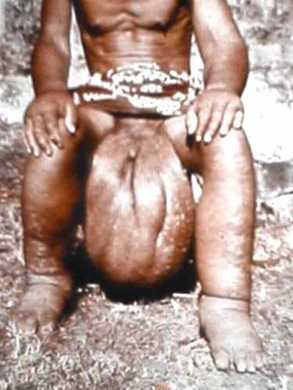
Elephantiasis: Why have the alarmists overlooked it?

Somehow I got to thinking about elephantiasis*, or lymphatic filariasis as its also known. Surely everyone has that defining moment when they first saw a photo of an unfortunate sufferer dragging his nuts around in a wheelbarrow, or is that just me?


It occurred to me the other day that the filarial parasite is spread by mosquitoes, and yet not once have I heard an alarmist warn that cimate change was going to lead to an increase in elephantiasis. Huh. Even a few quick literature searches hasn't led to much of anything specifically trumpeting the link. (Although I have discovered that November the 11th is National Filaria Day in India. Mark it on your calendar.)

Even the WHO managed to get all the way through a lymphatic filariasis fact sheet without once mentioning climate change or global warming. In fact, in an almost scary display of rationality, they mention in the first paragraph that:
In tropical and subtropical areas where lymphatic filariasis is well-established, the prevalence of infection is continuing to increase. A primary cause of this increase is the rapid and unplanned growth of cities, which creates numerous breeding sites for the mosquitoes that transmit the disease.


Double huh. To tell you the truth I am somewhat surprised. Doesn't elephantiasis have enough tropical freaky Ewww value to appeal to the warmists? Is malaria or dengue somehow sexier because it brings to mind pallid, febrile englishmen in pith helmets and white cotton shirts, artfully unbuttoned to expose chests bedewed with fever sweat? Or is that just me again? (Ahh, Paul, you can be the colonial overlord and I'll be the dusky, south seas maid.**)

I'm offended on behalf of the filarial parasite and elephantiasis sufferers everywhere. Were they disinvited from the climate and health gravy-train ride for fear they would take up too much space? What gives?


* Also considered as a title was "Is that elephantiasis, or are you just happy to see me?".
** My initial thought was to say "Lets play sahibs and dhobi wallahs", but decided that was possibly too wierd. Although not as wierd as the time a friend of mine, on his way to a fancy dress party, got into a lift dressed as an English officer of the Raj, only to discover the only other occupant of the lift was a middle-aged Sikh. When they reached the ground floor, the Sikh gentleman turned to him and said "Under the circumstances, sir, I think I should go first."

Thursday, December 17, 2009

Paul! Paul! Over here Paul!

For those of you who have been following my blog (and I really hope there are actually some of you), you will be familiar with the fact that my personal, teeth-grittingly-annoying bug-bear is misrepresentation of vector borne disease. Stupidity around malaria and the arbo-viruses just makes my blood boil, it led me down the climate skeptic path, and, well, here I am. Hi.

Thats why I have a bit of a crush on the medical entomologist Paul Reiter, hes so sensible and smart and has one of those quack-quack English accents that makes the laydeez swoon. He is still declining to let me have his babies, but undaunted, I will keep on stalking working on it.

If his impeccable qualifications and the fact that he told the IPCC to go jump aren't enough, he also has it in for everyone's favourite armchair entomologist climatologist president gravy-train ridin' hobo, Al Gore, and took the opportunity in The Spectator to once again put the boot in. (Fight! Fight! Fight!)

Instead of quoting it, I'll give you the link here, because it's worth reading it all.

Monday, December 7, 2009

Ecologists helpfully point out that doctors are crap at science

In a stellar example of how I am prepared to take one for the team in preparing these blog posts, I just sat down and read a series of articles presented in the April 2009 edition of Ecology.
It seems to have taken ecologists a little while to notice what the health professionals were running around saying about climate change invariably increasing infectious diseases and how vector borne diseases are already on the rampage. Possibly because, as Kevin Lafferty, the author of the paper that sparked the recent debate notes:

"For many ecologists, interest stops at the surface of the organism they study."

Now that they have noticed some of the highly questionable things that have been said, ecologists have weighed in on all sides of the debate in an Ecology forum. Even though there was some disagreement in the ranks about the extent that climate will drive infectious diseases, they all seemed to be in agreement that its not as simple as everyone has been making out, and it is often very hard to pinpoint where the effects of climate on disease begins and ends when taken into consideration with all the other inter-related variables. Also interesting to note was the fact that in most of the articles, the inference was that climate change was being discussed from the perspective of climatic variabilities, and not so much from a purely anthropogenic perspective.

Kevin Lafferty, from the U.S. Geological Survey's Western Ecological Research Center, notes in his article The ecology of climate change and infectious diseases, that:

although the globe is significantly warmer than it was a century ago, there is little evidence that climate change has already favored infectious diseases. While initial projections suggested dramatic future increases in the geographic range of infectious diseases, recent models predict range shifts in disease distributions, with little net increase in area. Many factors can affect infectious disease, and some may overshadow the effects of climate.
Richard Ostfield, from the Cary Institute of Ecosystem studies then weighs in with an article entitled Climate change and the distribution and intensity of infectious disease, in which he notes:

...unequivocal demonstrations of a causal link between climate change and human infectious diseases are rare (albeit increasing). Some diseases are likely to decrease in incidence and range with climate warming (Harvell et al. 2002), and others are likely to respond to precipitation or humidity more than to temperature, leading to poor predictive power under warming scenarios. Many diseases are strongly influenced by other ecological, sociological, economic, and evolutionary factors besides climate change.

In his concluding thoughts, he summises that "clear effects of climate change have now been established for several human infectious diseases" but then follows it up with the caveat:

Hay et al. (2002) close their critique of climate drivers of highland malaria by asserting, ‘‘The more certain climatologists become that humans are affecting global climates, the more critical epidemiologists should be of the evidence indicating that these changes affect malaria’’ (Hay et al. 2002:909). Good science demands that skepticism be applied equally to evidence for and against climatic effects on disease.

Mercedes Pascual and Menno Bouma then disagree on the basis that disease range shifts due to temperature are important (Do rising temperatures matter?) and that even if you think temperatures don't matter, then human activities such as changes in land use may increase infectious diseases anyway.

Harvell et al then use diseases in coral (these are ecologists remember) to point out that they think there is evidence of climate as a disease driver (Climate change and wildlife diseases: When does the host matter the most?), but then acknowledges that its complicated and host reactions and immune response may be important, too.

Then Andy Dobson from Princeton does a whole bunch of complicated things with numbers in
Climate variability, global change, immunity,and the dynamics of infectious diseases but seems to work out, among other things that:

Ultimately, the observed increase in malaria cases represent a complex interaction between climate change, human population expansion, the evolution of drug resistance, and the rapid expansion of the AIDS epidemic.
Teasing out the relative importance of each requires careful analyses of nonstationary time-series data where long term trends in global change, and annual seasonal variation in external forcing, interact with the intrinsic tendency of epidemic systems to cycle; this can produce very complex dynamics that defy simple statistical analysis.
Then reassures the reader that if you can give him lots of money he'll be happy to work it out for you.

My absolute favourite response comes from Sarah Randolph, a zoologist from Oxford, who points out in Perspectives on climate change impacts on infectious diseases, that over the last 450 million years so many species have become extinct that we really shouldn't get so worked up about a few climate related shifts in species distribution. She points out that the only reason we are getting so hysterical is that those species shifts might be pathogens that directly or indirectly affect homo sapiens. In summary, she says:

The complexity within each disease system emphasizes that any expectation of a simple consistent response to climate change, i.e., a universal worsening of the situation, is ill founded.
Hitherto, there is no single infectious disease whose increased incidence over recent decades can be reliably attributed to climate change. The often-repeated statistic, that climate change is currently causing approximately 150 000 extra deaths per annum, may be stamped with the authority of the World Health Organization (Campbell-Lendrum et al. 2003), but is, in the opinion of many practicing disease ecologists, inestimable. Furthermore, large as this number is in terms of bereavements, it represents only ;0.15% of all-cause deaths (as a first approximation, assuming a global population of 6.7 3109 and mean life expectancy of 67 years). Other, more avoidable, causes of premature deaths from infectious diseases deserve more attention than climate change.


So, in general, even though they seemed to be quibbling about which bit goes where (remind me never to get a bunch of ecologists to put together an Ikea cot), they all seem to be in agreement that:

1. Its complicated.
2. We don't know much and need to learn more.
3. Nobody should have left the public health mob, the sociologists and the climate scientists unsupervised for so long.
4. Scientific debate and skepticism is a really good thing.

If you made it to the end of this post with me, congratulations! Now as a reward, you can go to my last post and watch the models strip off in the name of carbon reduction.

Thursday, November 12, 2009

Why cutting carbon won't stop malaria

Climate Change and Malaria in Africa
Why limiting carbon emissions won't do much to stop disease

What I find most satisfying about the AGW debate is when you don't even have to debate the climate science because the conclusions drawn are faulty even if the world does get warmer. It makes the job much easier for those of us in the skeptic-but-not-a-climatologist crowd.

If you've been following this blog you will have realised by now that misrepresentations of mosquito born disease and AGW is my own personal bugbear. Bjorn Lomberg just said something eminently reasonable in a Wall Street Journal opinion piece:

Malaria is only weakly related to temperature; it is strongly related to poverty. It has risen in sub-Saharan Africa over the past 20 years not because of global warming, but because of failing medical response. The mainstay
treatment, chloroquine, is becoming less and less effective. The malaria parasite is becoming resistant, and there is a need for new, effective combination treatments based on artemisinin, which is unfortunately about 10 times more expensive.

Yeh. What he said.

I can also add a bit more about artemisinin, or qinghaosu if you speak Mandarin. Artemisinin was isolated from Artemisia annua, or Qing Hao as it's known in much of China. It wasn't just randomnly discovered by a big pharma lab, Chinese researchers went combing through traditional materia medicae for herbs that were indicated in what was probably malarial disease.
They managed to isolate qinghaosu (artemisinin) fairly easily, worked out it was an effective antimalarial, and then spent the next 10 or so years trying to convince the academic snobs of the developed world that they weren't making it up. Conveniently for everyone involved, Artemisia annua is a weed. In the US its common name is Sweet Annie and it grows everywhere. This is important because the "herb" that is commonly prescribed along with Qing Hao in traditional Chinese Medicine for tertiary fevers is soft-shelled turtle shell. If research had gone the other way, we might really have a problem of supply.

I don't think supply of artemisin is the real issue. Apart from the issue of why pharmaceutical companies can't be arsed making it and are charging too much for what they do, the real issue is that we are going to screw up with prescribing it just the same way we have done with the other antimalarials, and it won't be effective anymore. When artemisin was first coming onto the market, everyone solemnly swore that they were going to prescribe it in combination and use it wisely to prevent malarial resistance deveoping. Then it started being sold over the counter in Thailand and Papua New Guinea, among other places, and now its already too late. The big, bad malaria, P. falciparum, is already developing resistance.

So, to my mind, what we really need to prescribe it in combination with is something like DDT. Yes, I know, I know. DDT is evil, but so was Rachael Carson, if you ask me. Personally, I would have liked to see her writing "Silent Spring" on the Thai-Cambodia border and see how she felt about DDT by the end of it. I have heard its difficult to type when you're shaking with fever and your spleen is the size of an inflatable beach ball.

Wednesday, October 28, 2009

Aussie mozzie researchers agree that I was right all along...

A bunch of Aussie mosquito nerds or "entomologists" as they prefer to be called, have just looked at the constantly iterated claims that climate change will cause an increase in arboviruses like Dengue fever across Australia. They discovered that:

"...the dengue vector (the Aedes aegypti mosquito) "was previously common in parts of Queensland, the Northern Territory, Western Australia and New South Wales," and that it had, "in the past, covered most of the climatic range theoretically available to it," adding that "the distribution of local dengue transmission has [historically] nearly matched the geographic limits of the vector."

They conclude that ...

The vector's current absence from much of Australia, "is not because of a lack of a favorable climate." Thus, they reason that "a temperature rise of a few degrees is not alone likely to be responsible for substantial increases in the southern distribution of A. aegypti or dengue, as has been recently proposed." ... "dengue activity is increasing in many parts of the tropical and subtropical world as a result of rapid urbanization in developing countries and increased international travel, which distributes the viruses between countries."

(Russell, R.C., Currie, B.J., Lindsay, M.D., Mackenzie, J.S., Ritchie, S.A. and Whelan, P.I. 2009. Dengue and climate change in Australia: predictions for the future should incorporate knowledge from the past. Medical Journal of Australia 190: 265-268.)


For many of us climate skeptics, when we're not going to board meetings of Fortune 500 companies or relaxing on our country estates, there was a key moment when we thought "Wait a minute! That ain't right!" about a particular piece of information. Then we started to question the information being presented to us on climate change, asked some awkward questions, and before you knew it, the whole house of cards came tumbling down.

For me, that pivotal first moment was in a lecture on malaria. The lecturer was actually a well regarded malaria researcher who had been published in Nature (although I lost my faith in the peer review process right around the time they published a paper that predicted that all fish life would die out in 10 years time). He had displayed a slide of what they claimed was an Anopheles mosquito and then told us that due to global warming we would see an increase in mosquito borne diseases in Australia in the future.

My first thought was "Wait a minute! Thats not an Anopheles mosquito. Im no expert, (but I am a nerd) and that looks like an Aedes." Which kind of called into question his expertise as a malaria researcher as far as I was concerned. The next few thoughts went a bit like this:

  • Hang on. Ive got suitable malaria and arbovirus vectors in my backyard here in southern Australia. The bloody agapanthuses (agapanthii?) are full of them.

  • All of the arbo viruses (and Australia has several endemic varieties of our own) are notifiable illnesses.[i] Not only do the public health mob keep close tabs on cases, but the mosquito boffins do, too[ii], and this widely available information would indicate that not only are mosquito vectors found in all parts of Australia, but an overwhelming amount of cases are found in suburban southern Australia. Even Tasmania has the odd case, and it is almost equidistant between Antarctica and the tropical north of the country. (Re: Mosquito scientists. These are serious insect pervs, they have web sites where you can listen to the wing noise made by different species of mozzie. They must be telling the truth.)

  • Australia was only declared free of malaria by the WHO in 1981[iii], and has had several locally contracted cases since then[iv] [v]. Climate in any of its guises did not rid Australia of malaria, good public health did.

  • Additionally, even the briefest familiarity with medical history would indicate that there have been massive mosquito-borne disease outbreaks throughout history, even approaching arctic latitudes. Anyone who denies that mosquitoes are happy in sub polar regions hasn’t seen those nature documentaries of caribou choking to death on summer mosquito clouds. Oliver Cromwell was unfortunate enough to have died of what was probably tertiary malaria in England in 1658, which corresponds to part of what climatologists frequently refer to as “the Little Ice Age.”[vi]

It’s fair to say that I am by no means an expert on these matters, so it was gratifying to discover that some of those who are actually qualified to comment on this have issues of their own. See this talk by Paul Reiter, a medical entomologist who withdrew from the IPCC. (The last bit of the talk is particularly worth it just to see him stick it to Al "The Goracle" Gore).


[i] Arbovirus and Malaria Surveillance, Department of Health and Ageing.
[ii] The NSW arbovirus surveillance and mosquito monitoring project.
[iii] World Health Organization. Synopsis of the world malaria situation in 1981. Wkly Epidemiol Rec 1983; 58: 197-199.
[iv] Locally-acquired Plasmodium falciparum malaria on Darnley Island in the Torres Strait. Communicable Diseases Intelligence, Volume 25, Issue number 3 - August 2001
[v] Brookes et al. Plasmodium vivax malaria acquired in far north Queensland. MJA 1997; 166: 82
[vi] Reiter, P. From Shakespeare to Defoe: Malaria in England in the Little Ice Age. Emerging infectious diseases. Vol. 6, No. 1, January–February 2000.

Wednesday, October 21, 2009

Climate change and Mosquitoes

The medical entomologist Professor Paul oh, my god he's so hot I want to have his babies Reiter gives an excellent presentation on AGW and vector borne diseases.